Foraging for a Home Part 5: The South

Leaving Florida, we continued north to Savannah, Georgia, a city that until 2 hours earlier we had never, ever spoken it’s name.

On paper it has some of the best charm, nature and diversity one can ask for. But we simply didn’t fit in.

Like an art student in a room full of jocks, it was obvious we had nothing in common with the locals. Despite the city bustling with life at 11:00 pm, the pub and beer culture just wasn’t our scene.

We loved and appreciated the kindness, accents and fact that every passerby said “Hi there!” while walking their dog, but we couldn’t help but lack connection. Just like love often has no explanation, so does the feeling of home. And it simply wasn’t there.

One night was enough and we continued to Charleston, the prized city of the south. Had we been simply on “vacation” we may have enjoyed a few days, even a week in the extremely quaint city, however it was more of the same from Savannah.

It didn’t take us long to admit: the South just wasn’t our place. There was just too much monotony: of food, people (it’s not international, nor are there even people from all parts of the U.S), and style. Too much of one thing, even a good thing is still too much.

And so we left, grateful for the experience. When we visit a city we learn so much more than just our specific feelings toward that city, but our feelings in general. What things do we value in a home? How did our experience here help determine what we like and don’t like?

In Charleston, and all of the south, it’s simply too disconnected. Driving from Savannah to Charleston made us feel trapped and isolated. Even though Charleston is great, with a walk score of 93, when one has to leave it takes 3 hours to get to the nearest town, which apparently are equally uniform in style.
Everyone and everything it seemed, between NYC and Florida was quite similar…. which wouldn’t be a big deal if our lifestyle wasn’t so different and unconventional.

Without even meeting that many people, we could just tell we wouldn’t be understood or have like minded people to surround us with.

We not only eliminated Nashville and Wilmington from the list, but we confined our search to well connected, open minded and diverse metropolitan locations or cities with some tourist appeal so there’s always something going on.

We don’t want to feel out of place for having a 4:00 pm lunch on a Tuesday, or going to the gym at 10:00 am on a Friday.

And so, the journey continues, us still unsure if what we are looking for is even something we truly want.

– Me
Foraging For a Home Part 4: Florida

7 days, 6 nights, 10 cities (West Palm Beach, Delray, Boca Raton, Ft. Lauderdale, Naples, Sarasota, Sanibel Island, St. Petersburg, Tampa Bay and Orlando), and 1,500 miles sum up our road trip across Florida.

All in search of one thing: Home.

As we continue our search we continue to refine what we want out of a place to live. Florida is a stark contrast to the high priced, low value living of New York.

We immediately fell in love with West Palm Beach. The bustling farmers market – one of the best in the world – was our first contact with the city. We connected with the laid back, yet simultaneously energetic vibe of the beach life. Although a bit touristy, especially in January, WPB had personality.

With a serious latin influence and people migrating from all over the country in search of warm weather and low cost of living, WPB is quite diverse and offers an incredible selection of food. Perhaps it’s due to the fact that it’s extremely well connected. With 3 international airports within a 1 hour drive (Miami, Ft. Lauderdale and WPB) and a high speed railway that will take you to Miami in under an hour, it’s perfect for our jet-settling lifestyle. Even if one wants to stay close they have options. Delray Beach, a hip and happening beach town, and Boca Raton – especially Mizner Park – are just minutes away and equally spectacular.

Looking at property is always a telling moment, and here’s when we really felt like we could someday call this place home. We saw a 6 bedroom, 4 bathroom house on 3 stories for $289,500, just a short bike ride from town. Granted it needed some work but compared to the usurious prices and taxes of California and NYC, it was hard not to be attracted to the place.

This cheaper lifestyle seemed to transverse all aspects of ones lifestyle, from gas prices under $2.00 to reasonably priced organic vegetables.
… the only thing we left wondering was, why weren’t more people living here?

It saddened us to leave the next morning. But Delray and Boca Raton were calling.

On paper Delray Beach has everything: a vibrant downtown, easy access to the water and many of the perks of WPB. However, after looking at property and spending some time there, it just didn’t feel like home.
We left after a day.

Boca Raton was cool – including one of the world’s best Whole Foods, but lacked the downtown walkability that was so prevalent in WPB. We continued on to Ft. Lauderdale, only to drive through realizing that it was too busy and trafficked for our taste.

Which took us to the West Coast, with promises of the countries most beautiful waters and beaches.
And it delivered.

When we arrived in Naples, we almost cried witnessing the pearly white sand and the way the water glowed in the sunset. We truly didn’t want to leave the quaint, mesmerizing downtown, and we may not have if the real estate agent hadn’t told us that the barrier to enter was over $1,000,000.

The rest of the city was spread out and full of old people – we literally looked in a 55+ community, which, is as depressing as it sounds – and so, after one night we left.

The only thing the rest of the West Coast offered was made us realize we liked the East Coast. Sarasota, Clearwater, St. Petersburg and Tampa are all painfully old and rather dull. We drove through quickly before making our way to Orlando, “wife’s” former home, before “me”.

It’s not the same as when we were there before, because being in a different part of your life makes you see the same reality differently. We were surprised at how much and how quickly we fell in love with the charming Winter Park, a high end community nestled in the north-east of the terribly trafficked Orlando.

Walking through the eclectic shops and beautiful nature, with lush Spanish moss covering the trees with its hanging tentacles, one gets completely lost in it’s beauty. It didn’t hurt that we found our absolute dream home – a 4 bedroom, 3.5 bedroom palace of 3,500 square feet, just a few short steps from the town’s center.

It both scared and confused us.

Were we ready for such a purchase? What would we use it for? Could the same money be spent elsewhere for investments while we flexibly rent in the mean time?

When it came time to actually moving forward, we got cold feet. Maybe a huge, high maintenance home isn’t what we wanted after all. Is it really valuable to own a home, or was it more likely that the home would end up owning us?

Trusting our inclination, yet certain to return to Winter Park, we opted to continue on our journey, except this time with newfound insight. It made us realize that WPB was more of a place where one can come and go… the high tourism population meant the city didn’t hold you down.
Winter Park was different – a family lifestyle and big home was something the city begged. If and when we ever get there, at least we’ll have a good place to be.

For more house hunting videos, check out our YouTube Chanel!

Foraging For A Home Part 3: New York City

We absolutely love it here. It’s a bold statement to call something the best, but Manhattan just may earn the title. From the diversity (on one corner in Chinatown they sell Peking Duck, and directly across in Little Italy it’s Parmigiano Reggiano), the incredible efficiency (even Whole Food delivers), to the accessibility, NYC has something for everyone.

We could put up with the freezing cold… shivering our ass off strolling through the charming streets of the West Village still beats the 0 walk score solitary confinement that comprises most of America.

The city truly does never a sleep: an epic protest across the street lasted throughout our 20 day stay, and the ambulances and fire trucks seemed to opt for our street to transverse Manhattan. That’s okay though, it kept us out and about instead of idling on the computer.

But when it came time to viewing places to actually live our opinion changed. A 700 square foot condo that costs $2,000 a month to maintain for 1.3 million? It’s telling when it feels like a bargain to rent the same place for $5,000 per month.

And what if you have kids?

Three strikes and you’re out.

Temporarily that is. If we ever accumulate 10,000,000 dollars, 2 will surely be punted on that epic high rise overlooking the most incredible city on the planet. Even if the kids have to sleep in the kitchen.

Should Tipping Be Mandatory?

It was a snowy day in Manhattan, and the standard 25 minute trip to JFK took over an hour.

When we finally arrived, I quickly scanned my credit card and rushed for the bags.

“$4.00 tip? You serious? On a $55 dollar cab ride in the snow!”

Tipping is not about the money, but what the money represents and what the consumer expects from the service.

After our quarrel I felt guilty. $4.00 was a little lower than what one would expect to tip given the circumstances.

… and that’s the point. Tips are expected.

The fact I felt guilty stems from my belief that I underpaid what I owed, when in fact, I owed nothing at all.

Tip (to insure prompt service), is meant to do just that. This cab driver was by no means out of the ordinary (in fact, when you stop and think about it, is there really a way a cab driver can be extra ordinary?) He talked loudly on the phone, which, in a normal circumstance would be forgivable had it not been for the absurd fact that he was wearing a microphone which augmented his voice over ours.

But measuring his actual service has become almost irrelevant. What happens to a system whose purpose is to ensure prompt service when the people who work in it have grown to expect a tip?

It de incentivizes the person providing the service to care about the quality which they are providing.

… which is the whole point of a tip in the first place!

Tips have become annoying expected.
Hair stylists, taxis, night club hosts and bellmen are among the few who work on tips.

It’s become so socially accepted that employers now get to freeroll off the consumer. Waiters are paid lower salaries because much of their income is derived from tips.

Is it really the responsibility of the consumer to employ the person serving us food?

My personal favorite is when restaurants add an automatic 18% gratuity to parties of 6 or more. Should we really be taxed for bringing our friends to dinner… and have no recourse to vote with our dollars as to the quality of service?

Just to be clear I’m not against tips. But when we tip everyone for everything the act loses credibility and stops serving its purpose.

The most ridiculous part of this whole thing?
… that it takes something like this to happen for us to question the system that we blindly allowing to continue.

– Me

Mo Money, Mo Problems

It’s rare that one should take wisdom from a rap song. But all rules have exceptions. ‘Mo Money, Mo Problems’ seems to defy such sound logic.

The concept is quite profound. One cannot begin to tally the literature filled with stories of those who believe that money (specifically, more money) will solve all their problems. In its most simplified form the problem exists in two ways: wanting something more or wanting something less.
More: things, toys, houses, cars, free time, travel, etc.
Less: work, errands, chores, etc.

Money can solve all of the above problems. But has anyone ever stopped to think about why that is actually valuable? It can only be because its presumed to bring us more happiness.

I’m not going to attempt to be profound and bore you with the myriad of studies that show conclusively that money and happiness aren’t linked (beyond basic need of survival). Instead I’m going to take on a new theory (or rather borrow from my good ol’ friend Notorious BIG), that more money, beyond a certain point, causes more problems.

Perhaps the single biggest reason that it’s so absurd, even insulting to entertain the idea that an more money leads to unhappiness is because we’re taught to spend our whole lives chasing wealth. If we work backwards (the end being the pot of gold and retirement), nearly every decision we make stems from the promise of financial gain: go to a good school, get a good job, make lots of money, the latter being the proof that the former are worthy pursuits. Too many have spent too long living under this assumption without once asking why do it all in the first place?

Even if more money doesn’t mean more happiness, avidly pursuing wealth doesn’t seem like a bad idea; at worst the critics are wrong (and money does lead to happiness), and at best one can expect to “break even”. In other words it’s a free roll: one cannot lose, they can only gain. The flaw in this theory (even if people don’t actively admit this, their actions seem to emulate this belief), is that the pursuit in and of itself is extremely stressful. People spend their entire lives under the delusion that more money (or more of anything) will bring them happiness. Ironically, it’s this very belief that causes them to be unhappy.

And let’s say one does acquire a decent chunk of change, even easily or through enjoyment, like say yours truly has. Ok, now what? The foolish who think they’re going to sip pina coladas on a secluded beach are neglecting the fact that it gets extremely boring after a few go arounds. Fulfillment (which is supposedly what you want that money for), doesn’t come from doing nothing all day. And besides, how much can you really spend on a few nice vacations? $5,000? $10,000? $20,000?
It’s like school, you’re so glad when it ends, and while it’s always bitter sweet when it’s time to start again, if you’re being honest you’re actually looking forward to it.
It’s not the work that bothers us, so much as the consistency of it. But once our batteries are recharged we’re ready to go again.

Then you buy a few nice things, the high of which fade away as fast as a bump of cocaine. Then either one of two things happen: you feel like an absolute putz for punting away the money you realize is so hard to get, or you keep chasing these cocaine highs your whole life, except through material form.

But it wouldn’t be so bad if the excitement of having money just wore off after a little while. You’d just be in the same mental spot as all the broke people, except with the knowledge that your life is really no different. No harm done. The problem is that having money actually creates more fucking problems. Assuming you weren’t an imbecile and kept most of it, you have to do something with it. That means making choices, most of which we know nothing about. And choices, especially hard ones which have big consequences, create a lot of stress. Because we kept our money we feel entitled to it. We know how precious it is and we have to nurture it, and constantly grow it. For those whom are saying, “you would just be content if you had (insert amount of money here), you simply are wrong. The truth is if you’re not content now you never will be. People always want more. And the addition of money to one’s current situation only expands that desire, not decreases it.
Still don’t believe that money is all relative? Think of all the people in the world that would be wishing to fill in the blank with YOUR life. If they were you they wouldn’t want anymore, so why should you?

So here we are with our million dollars, without a single fucking clue as to what the best investments are. Maybe we’ll buy a house, rent it out and if the market is just right hope someone else pays our mortgage. Of course there’s paperwork, meetings with the bank, real estate agents, loan applications, dealing with tenants whom don’t pay rent and property management companies who don’t tell us that our tenant paid rent. Stressful.
We may opt for a passive income like stocks. But then we’d consult with a broker, realize he too doesn’t know his ass from his elbow (because if he did he’d be investing his own money, not ours), but we’ll buy the safe stocks anyway because that’s what everyone else does. Maybe they’ll go up, maybe they won’t. But in the end it won’t really matter. We’ll just have a meeting with a lawyer and accountant about what to do if we ever sell, how to avoid capital gains tax, how to move our residence so we can sell our second home, but claim its our first so we don’t pay capital gains on that either.

We’ll complain when the tax laws change, start voting republican they offer some tax cuts, and pick up Forbes magazine to look for ideas. It will consume us instead of liberate us. And instead of spending weekends enjoying sipping pina coladas, (which by the way, don’t cost much money), we’ll sip them on our cell phone with our magazine. And we’ll wonder how we never have time to do the things we did when we were broke, and reminisce of the good ol’ days when we were just kids, and talk about how it all started.

I know because at times I’ve been one of these people. I also know some happy people with money. Sure there are some. The happiest of whom give it away.

Foraging for a Home Part 2: Milan

With the promise of a well connected, urban environment that maintained all the charm of Italy the idea that we have found our home looked promising. The week prior to our visit in Milan we did hours of research, narrowing our real estate appointments down three neighborhoods: Arco della Pace, Chinatown, Brerea.

Chinatown made us feel like “home” in a way, reminding us of the months we spent in Hong Kong. The men wheeled around supplies on the streets, red lanterns hung for good fortune, women enticed passerby’s for massages. But it was still Italy. People drinking coffee smoking cigarettes on carless streets. It was hectic, busy, quiet, and charming all at once.

Things changed when we looked at places and actually imagined ourselves living there. Pointing to a still undeveloped building with a questionable bar across the street that My Italian Wife didn’t want to stop for a coffee I thought, “so this is where the kids are going to grow up?”
Life there became real, and we dismissed it really quick.

Arco della Pace was a bit too quiet, and homogenous albeit having an incredible private school which only cost €8,000 a year (it would be much more for the equivalent in say, New York City).
Aside from that we saw no enticing places and apparently there weren’t any available.

Brerea was truly charming, and if we chose to live in Milan it would be there. The problem is that you’re not buying anything nice for less than €10,000/sq meter (€1,000/sq. ft), and we weren’t willing to settle on less than 70 meters (700 sq feet). After all we live and work from home. Add in a potential kid and it’s really hard to do with much less.

Quickly weighing our options we realized that for $1,000,000 U.S. we could live literally anywhere… did we really want to spend it in Milan? Big questions put into such immediate perspective makes one rethink things. Yes Milan is wonderful, but is it our first choice? After all we had no economic there.
But what about being close to family? Nearly a two hour train ride away, how often would we actually see them? Hardly ever. Big questions and real answers.

We could of course rent and never buy for a usurious €3,500/month for something half way decent, but that wasn’t so appealing either. In asking ourselves why we realized we didn’t want to move, meaning we didn’t want to live somewhere short term. What’s the point of investing and settling down if you’re going to do it all over again in a couple of months?

If my experience in Milan taught me one thing it’s that we had some of our priorities wrong. Maybe long term was more important after all… And what about being close to family? To really make it count, you need to either be right there or you might as well be anywhere? And further still… would it be her family in Italy or mine in California?

Big questions… still no answers.

All Grown Up

How does one know when they’ve finally become an adult?

Society says 18. I say bullshit. Thinking back to those days I can’t say I was grown – not in the slightest.

How did I know? Because everyone else seemed so much older; I still looked at them with awe and wonder, for what it must be like to know what they must know.

25 is when I first felt like an adult. It’s when I truly realized that the people older than me, 30, 40, 50 don’t have some magical wisdom or the answers to everything.

They’re people, with fears, ambitions, insecurities who want – no, who need – to be loved… just like you and me.

Foraging for a Home

My wife and I did things backwards. We married a year and a half ago, but still don’t have a home. Let me explain.

We travel for a living. Our business is online and we’re fortunate enough to be wherever we want, whenever we want.

And we’ve done just that. Bali, Thailand, Italy, France, Hong Kong, Malta, Las Vegas, Orange County, London and Barcelona are a few of the places we’ve called home over the last two years.

Everything we physically own we can carry in two suitcases and we never plan more than a few days, or one city ahead. That’s the rule.

Well, rules are meant to be broken. Tired of taking road trips with a Vitamix, we decided it might be time to find our nest. The problem is where?

How does one choose when they can be literally anywhere in the world? I started with the Economists guide to the “Best Places to Live”. That narrowed it down to three continents.

Half way there.

Talking to family, friends and anyone and everyone we met, we realized that nobody really had a system to which they chose their place to live.

95% were out of practicality. They had work or family there and simply didn’t have much choice. The few whom could chose inevitably lived close to home, thus in a way, opting not to exercise choice.

We suffered from yet another first world problem. What started as a blessing now seemed like a curse. We didn’t have the “luxury” of not choosing. The mere fact that my wife’s Italian and I Californian meant we would have to do some serious grinding, and put together a list of our top priorities.

Here they are:

Me                                                                                                    My Italian Wife
DEAL BREAKERS

  • Price: Want a place where                                  Weather: Not too cold in winter. Hot summers.
    we can afford 1000 sq feet
  • Safety: Would I think twice about                     Family: It’s gotta be close.
    my wife walking home alone at night?


EXTREMELY IMPORTANT

  1. Opportunity: What about this city               Walkability: Can I live there for a week without having to drive?
    makes me want to be there?
  2. Healthy: Food, air, fitness, lifestyle            Connection: What towns are nearby? How easy is it to get there?


MODERATELY IMPORTANT

  1. Functionality: modern, walk score, ease of life        Ease of Travel:
    accessibility to daily life
  2. Weather: Don’t care about temperature                     Nature:
    but I need sun!
  3. English: Need to do business in my own language   Close to Water:
  4. Taxes: I don’t want to get extorted                                Quiet: Even if in the city, need our own place to escape or detach


LESS IMPORTANT

  1. Ease of Travel: Is it close to a major airport?          Safety: Not important… Batman will protect her
  2. Long Term: Can I raise a family?                               Healthy: Good, organic food
  3. Close to Parents: Sorry guys.                                     Healthcare
  4. Healthcare                                                                      Long Term: Can I raise my kids?


It’s good that I married a woman whom doesn’t have the same priorities as me. Oops.

Then we each made an independent list of cities we thought would best fit the above.

Me                                                       My Italian Wife

MUST SEE

  1. San Diego                            1. Milan
  2. Boulder                                2. Bardolino
  3. Antibes                                 3. Antibes
  4. New York                             4. New York
  5. San Francisco
  6. Vancouver
  7. San Luis Obispo
  8. Milan
  9. Beverly Hills
  10. Portland 

    POSSIBILITIES

    1. Malta              1. Malta
    2. Monaco         2. Monaco
    3. Honolulu      3. Frankfurt
    4. Zurich            4. Prague
    5. London         5. London

Bad News: We didn’t have much in common for our top priorities.
Good News: We both agreed on several cities: Milan, Antibes, New York.

So we started our adventure. Given our proximity at the time of this writing, we decided our first stop would be Milan. It’s time to find a home!

A Glass of Water

Three times I asked the same waiter for a glass of water. Three times I got the same response: “un momento.” It wasn’t only the fact that he completely neglected my order, but it was how he did it that was so perturbing. His face said it all: eyes rolling with a sigh loud enough that I could hear.

Had this been an isolated event I wouldn’t have thought anything of it. But such lento behavior was typical in Spain. The waiter had no reason to care. Establishing good service would neither help nor hurt him. His compensation, job and life would be exactly the same.

In ordering a glass of water one sees the problem with the entirety of such a system when one has no incentive to work. It breeds laziness. There are, of course exceptions to the rule, and I’ve had plenty good service in many parts of Europe. Please don’t write to me with your trivial counter example.

I’m aware that there are examples of exemplary service in places where no incentive (in this case, tips) are required. Southeast Asia is a perfect example. Something about the way the hierarchical system (they effectively still have a class system culture) affects the mindset of the working class produces the best, most authentic service in the world. Such is simply not true in a socialistic culture like Europe.
Drawbacks include people being generally slow, not highly trained and difficulty in thinking outside the box. One can get frustrated trying to place a complicated order. They may have the best intentions, but they often get it wrong… after you wait 20 minutes.

Then there’s the U.S. Undoubtedly the service is much better there, arguably the best, but the incentive based system has its drawbacks. Common complaints are people learning to expect tips, which renders them complacent. Another is that the people are largely fake, only providing efficient service to extract tips from customers, which of course, isn’t a pleasurable experience.
Comparing the three systems, my favorite is the U.S. or Asia.

I’m liable to annoyed ordering water in the U.S. – the fact I have to tip for such a trivial service is absurd to me. But at least they’ll get my order correct, and fast.

Asia is nice when you’re on vacation, but after a while it gets old. I’ll get my water, I’ll just have to wait 20 minutes for it. And it may come with an unexpected side of some feces, which will lead to diarrhea and food poisoning for a week.

But both options still beats Europe. At least the former two countries bring me the fucking glass. In Europe, I’ll just be thirsty.

Helping People to Move Well. Eat Well. Feel Well.

This is the motto of the nicest gym in Barcelona, the Equinox of Spain. With hundreds of classes to chose from, state of the art equipment and well informed instructors, one feels at right at home. Since everything was “closed on Sunday”and I couldn’t shop for groceries, I would enjoy my Monday morning breakfast at the gym.

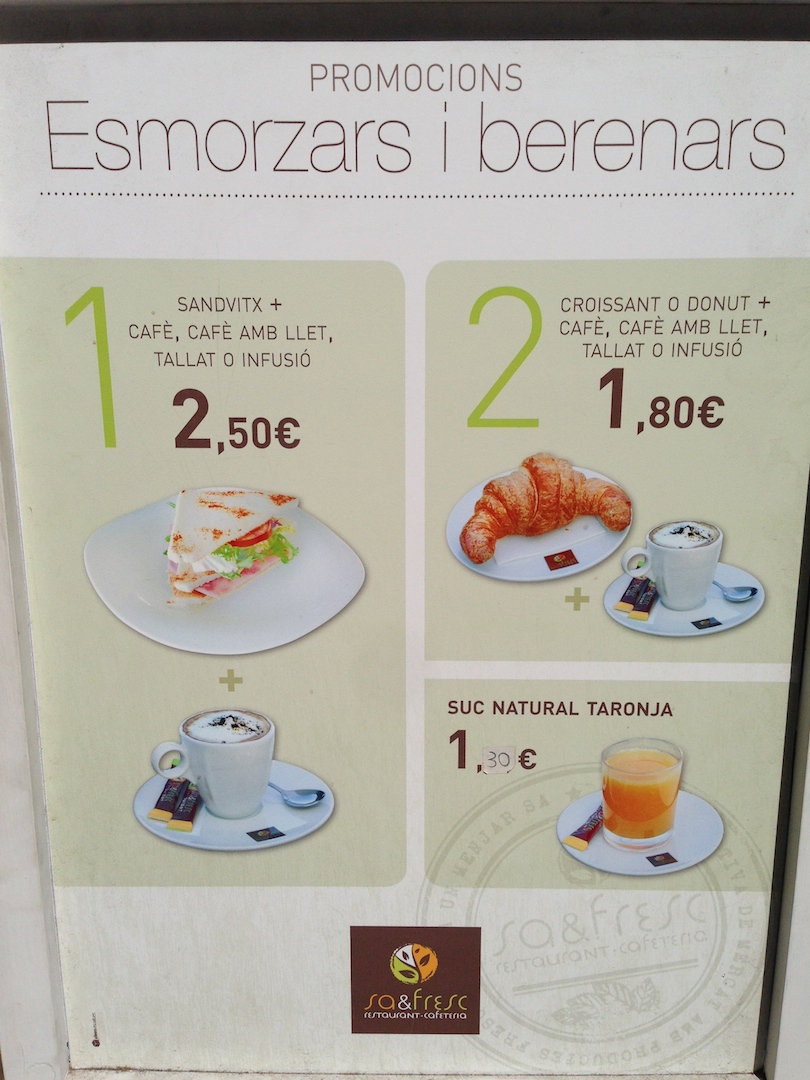
I was a little dismayed when I saw the selection posted outside. The picture offered a special, a croissant and coffee (with sugar, free of charge) is €2.50.
If they didn’t feel like indulging, they could opt for the panini, with white bread, cheese and cured meat. Breakfast of champions.

Holmes Place

While I think it’s absurd that a gym, a mecca helping others to “eat well”,  offers such selection, I believe in choice and free market. So I neglected the offer for the “daily special” and asked for a smoothie. They don’t make them. Salad? No. Protein Shake? The waitress referred me to the industrial, highly processed, chemical composition. The truth is that this and a few pieces of fruit was all they offered.

It’s deeply saddens me that confused societies exist with this at their foundation. Health is so dramatically undervalued in our lives that it’s a disgrace that the places that should be on the cutting edge of change are the perputrators of the problem. Isn’t a world where it’s not uncommon for 50% of the population is obese enough for people to wake up? Where new diseases like Type 2 Diabetes are flourishing and cancer is rampant?

It’s only half of the problem that the “healthy” places offer such a terrible selection of food, but the bigger, more absurd half if that I’m likely the only one complaining about it!
Market reflects demand.

Or does it? The inclination from the clueless individual is to think that it’s somehow a sacrifice to drink green juice instead of eat a croissant, when in reality it’s their body that has habituated to the wrong substance. They don’t even know what it’s like to feel energetic, lean, alert. They exist in their mediocre state of lethargy, thinking that it’s normal to need stimulating like caffeine to stay alert and alcohol to relax.
With great power comes great responsibility. The owners of institutions like gyms who are beacons of health have a duty to inform the public. They should suggestively educate the public on healthy alternatives to dated practices of breakfast.
Part of Europe’s charm lies in tradition. But some things are better with change. We don’t live in a world where wheat needs to be a staple because of troubled economic times. People can afford organic green juice. If they think they can’t, it’s time for people to re prioritize how they spend their money and augment the importance of health to a core value in their lives.

Let’s encourage those institutions near us to uphold their responsibility to serve the public interest and encourage a healthy lifestyle for the future.